Educational Exchanges as Potential Influence Channels

Article by Marie D.
Published on September 30, 2026 12:00PM
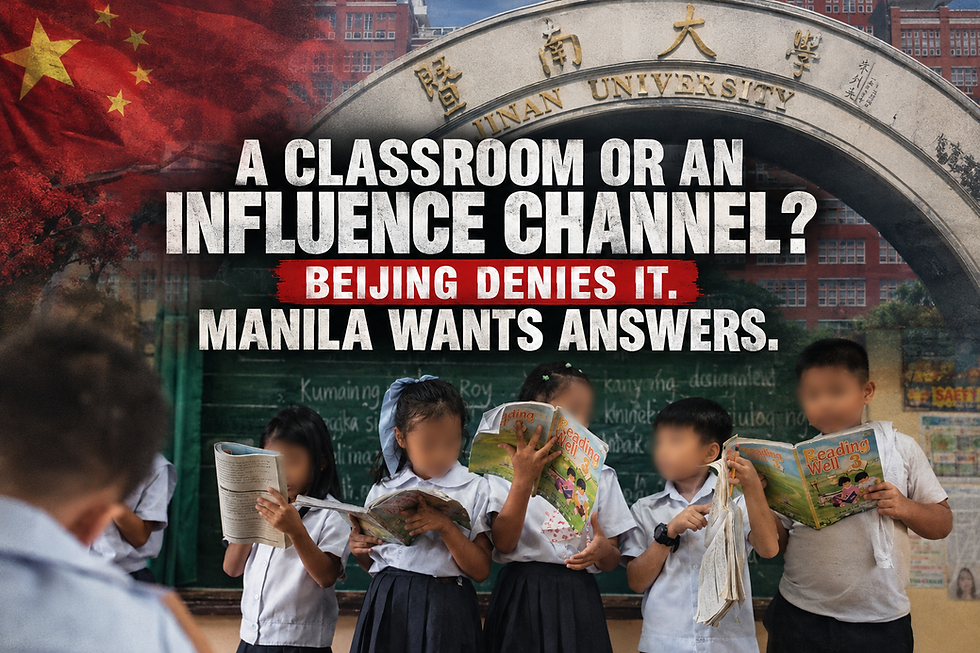
Philippine security officials have raised concerns that Chinese educational exchange programs, particularly those linked to mainland Chinese institutions, could serve as conduits for foreign influence operations within the Philippines. According to a July 2026 investigation by SeaLight, a maritime transparency initiative, Jinan University in Guangzhou has been identified as the primary training destination for Chinese-language teachers working in Chinese-Filipino schools across the country. ¹ ² ³
Alleged Institutional Networks and Influence Mechanisms
SeaLight's report alleged that Jinan University is part of a broader network linked to the Chinese Communist Party's United Front system, which the organization claims is involved in multiple aspects of Chinese-language education in the Philippines, including teacher training, language testing, curriculum development, internships, and job placement. The report characterized these activities as a "foreign influence operation" designed to promote Beijing's narratives and political perspectives through educational and cultural programs. ¹ ⁴ ⁵ ⁶ ⁷
According to SeaLight, organizations linked to the CCP's United Front system have become primary intermediaries between mainland Chinese institutions and the Philippines' Chinese-language education sector, with efforts to expand their reach into mainstream classrooms. The report identified two (2) major programs, the "Blood Transfusion" program, which began in 1991 and brought thousands of mainland Chinese teachers to the Philippines to work in Chinese-language schools, and the "Blood Generation" program, which sent Filipino-Chinese students to Chinese universities for teacher training with the expectation that graduates would return to the Philippines. ¹ ⁸
Security Officials' Concerns About Recruitment and Influence
Defense Secretary Gilberto Teodoro Jr. stated that Philippine authorities had seen information suggesting that educational exchanges could be used "to gain a foothold into the Philippines in order for them to scope for information." While Teodoro did not explicitly allege that teachers were recruiting Filipino targets, his remarks implied that academic collaborations and institutional links could serve as tools for information collection and influence operations. ¹
SeaLight director Ray Powell, argued that teacher training, educational cooperation and cultural programs can function as channels through which Beijing promotes its narratives and political perspectives to students and broader communities. The report suggested that Chinese-language teachers, through their institutional ties to mainland universities and CCP-linked organizations, could potentially influence students' political views or identify individuals for further engagement. ¹ ⁴ ⁶
Philippine Government Response and Calls for Oversight
In response to these concerns, Teodoro called for tighter supervision by academic bodies and greater transparency regarding foreign state funding in local education, describing such measures as "fundamental duties of national governance" necessary to protect both academic integrity and national security. The Defense Secretary emphasised that public scrutiny and institutional transparency were vital to safeguarding Philippine sovereignty amid what he described as potential national security risks from China-linked educational programs. ¹ ² ³ ⁹
The Department of National Defense stated that foreign state-backed academic and cultural exchange programs needed to be put under greater scrutiny, citing concerns about the influence of Chinese state-linked institutions on local education. Teodoro's remarks came amid broader tensions over the West Philippine Sea, where repeated confrontations between Philippine and Chinese vessels have heightened scrutiny of all forms of engagement with Beijing. ¹ ³ ⁹
Beijing's Denial and Counter-Narrative
Beijing has rejected these characterizations, with Chinese officials and state media dismissing SeaLight's report as unsubstantiated. The Chinese embassy in Manila branded Teodoro "extremely anti-China" and accused him of seeking to "interfere with and undermine China-Philippines relations, sever the friendship between the Chinese and Filipino people, and create antagonism between the two (2) countries and their people." ¹⁰
Chinese state media and officials have maintained that the teacher training programs conducted by Jinan University for Philippine Chinese schools are "entirely lawful, transparent and aboveboard," and have accused Philippine security officials of politicizing educational and cultural exchanges. The Global Times, a Chinese state-run newspaper, published an article in which Dai Fan, director of the Center for Philippine Studies at Jinan University, said Philippine authorities were stretching the concept of national security too far and were treating Chinese-language education programs as a security risk without providing sufficient evidence. ¹⁰
Context and Implications
The allegations reflect broader geopolitical tensions between Manila and Beijing, particularly over maritime sovereignty in the West Philippine Sea near Philippine islands such as Pag-asa Island (Thitu Island / Sandy Cay) and Panatag Shoal (Scarborough Shoal). Philippine security officials have increasingly flagged Chinese-linked educational and cultural programs as potential vectors for influence operations, particularly as tensions over fishing rights, coast guard encounters, and infrastructure development on features in the West Philippine Sea that fall within the Philippines' exclusive economic zone have intensified. ¹
The controversy underscores the delicate balance Philippine institutions must strike between preserving cultural and educational ties with China and addressing national security concerns raised by government officials. For Chinese-Filipino schools that have relied on these instructors for decades, the situation presents significant operational challenges as administrators seek to maintain language programs while navigating heightened scrutiny from security agencies.
____________________
Notes:
¹ tribune.net.ph. Teodoro Calls for Scrutiny of China-Linked. https://tribune.net.ph/2026/07/29/teodoro-urges-scrutiny-of-china-linked-education-programs
² US News. Philippines Defends Efforts to Put China-Linked Education Programmes Under More Scrutiny. https://www.usnews.com/news/world/articles/2026-07-31/philippines-defends-efforts-to-put-china-linked-education-programmes-under-more-scrutiny
³ PNA. DND calls for educ transparency, PH sovereignty amid China issue https://www.pna.gov.ph/articles/1280768
⁴ SeaLight Foundation's Post https://www.linkedin.com/posts/sealight-foundation_china-taiwan-ccp-activity-7487671009723195392-P6Qj
⁵ MANILA Times. Gibo's geopolitics marches into the classroom https://www.manilatimes.net/2026/10/03/opinion/columns/gibos-geopolitics-marches-into-the-classroom/2438079
⁶ GMA News. Grupong SeaLight: Jinan University kung saan nagsasanay ang ilang... https://www.gmanetwork.com/news/video/unangbalita/763052/grupong-sealight-jinan-university-kung-saan-nagsasanay-ang-ilang-nagtuturo-sa-chinese-filipino-schools-isang-foreign-influence-operation/video
⁷ tribune.net.ph. China’s decades-long indoctrination drive targets. https://tribune.net.ph/2026/09/17/chinas-decades-long-indoctrination-drive-targets-filipinos
⁸ Internazionale. Philippines defends efforts to put China-linked education ... https://www.internazionale.it/ultime-notizie-reuters/2026/07/31/philippines-defends-efforts-to-put-china-linked-education-programmes-under-more-scrutiny
⁹ China Daily. Manila's China hawks seek to hijack ties by restricting people-to-people exchanges. https://www.chinadailyhk.com/hk/article/637759
¹⁰ Global Times. Philippine defense chief criticized for smearing Jinan ... https://www.globaltimes.cn/page/202607/1367194.shtml


Comments